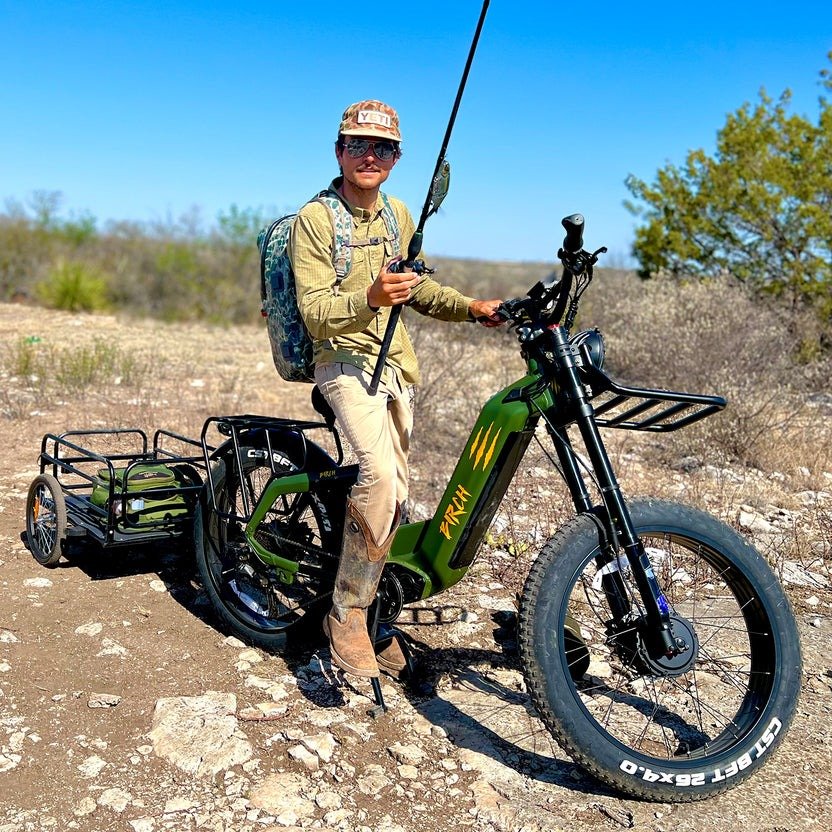
The Complete Guide to Riding an E-Bike with a Trailer

Adding a trailer to your hunting electric bike is a total game-changer. Whether you’re a parent like those in the Momentum Biking community, a hunter like Grant Hardy, or a backcountry explorer like Blake King, a trailer transforms your e-bike from a simple commuter into a legitimate “hauling machine.”
However, towing 50–100 lbs of extra weight changes the physics of your ride. Here is how to master the art of the e-bike trailer without breaking a sweat (or your bike).
1. Choosing the Right Connection
Before you hit the road, you need to ensure your “hitch” is solid. Most modern e-bikes use thru-axles or nutted axles, which often require a specific adapter to fit standard trailer hitches.
- Two-Wheel Trailers: Best for stability and heavy loads (groceries, kids, or large game).
- Single-Wheel Trailers: Narrower and more nimble—ideal for tight single-track trails or logging roads.
- Pro Tip: Always double-check your e-bike’s manual for its Gross Vehicle Weight Rating (GVWR). Exceeding this can strain your motor and void your warranty.
2. The Physics of the Pull: Riding Technique
Towing with an e-bike feels easy because of the motor, but the “push-pull” effect of a trailer can be tricky.
Master the “Wide Turn”
A trailer doesn’t follow your exact path; it “cuts” the corner. If you turn too sharply around a curb, your trailer wheel might clip it and flip.
The Rule: Take every corner 20% wider than you think you need to.
Braking: The 50% Rule
Weight in a trailer pushes your bike forward when you try to stop.
- Anticipate: Start braking twice as early as you normally would.
- Even Pressure: Use both front and rear brakes simultaneously to prevent the trailer from “jackknifing” or pushing your rear wheel to the side.
3. Battery & Motor Management
Towing is a “High-Drain” activity. To keep your battery from plummeting:
- Maintain Cadence: Don’t rely solely on the throttle. Keep your legs moving to help the motor stay in its “efficiency zone.”
- Downshift Early: If you see a hill coming, shift to a lower mechanical gear before you start climbing. This reduces the heat buildup in your motor.
- The 1000W Advantage: If you regularly haul over 100 lbs, a 1000W motor or a Mid-Drive system is highly recommended to handle the torque requirements without overheating.
4. Safety First: Visibility and Loading
A trailer sits low to the ground and is often invisible to cars behind you.
- The Flag is Mandatory: Always use a tall, high-visibility safety flag.
- Low Center of Gravity: Load your heaviest items (like an elk quarter or a cooler) low and centered over the trailer axle. Placing weight too far back causes “fishtailing” at high speeds.
- Tire Pressure: Check your trailer tires! Under-inflated trailer tires create massive drag, killing your e-bike’s range.
5. 2026 Legal Quick-Check
In many regions (especially the UK and EU), e-bikes towing trailers are often restricted to a maximum speed of 15.5 mph (25 km/h). Even if your 1000W beast can go 30 mph, doing so with a trailer can be unstable and, in some places, legally classified as operating an unlicensed motor vehicle.